
How Dhokra Handcrafted Products Are Made: When Wax Disappears and Art Remains
Have you ever looked at a Dhokra figurine and wondered how something so detailed could be shaped without a machine? Why does every curve feel personal, every pattern slightly different, and every surface seem to hold a story?
The answer lies in one of India’s oldest metal-casting traditions: the lost-wax process.
Dhokra Handcrafted Products are not simply made. They are imagined in wax, protected in clay, transformed by fire, and finally revealed in metal. The journey is slow, precise, and deeply human.
What Makes Dhokra Different?
Dhokra is a traditional metal craft known for its rustic texture, antique finish and intricate hand-worked patterns. Artisan communities in Odisha, Chhattisgarh, Jharkhand and West Bengal have used this technique to create tribal figures, animals, jewellery, lamps, cultural icons and decorative objects.
But here is the fascinating part: can the same mould create another identical piece?
No. The mould is broken to reveal the finished artwork. That is why every traditionally made piece carries its own character.
How Does Wax Become Metal?
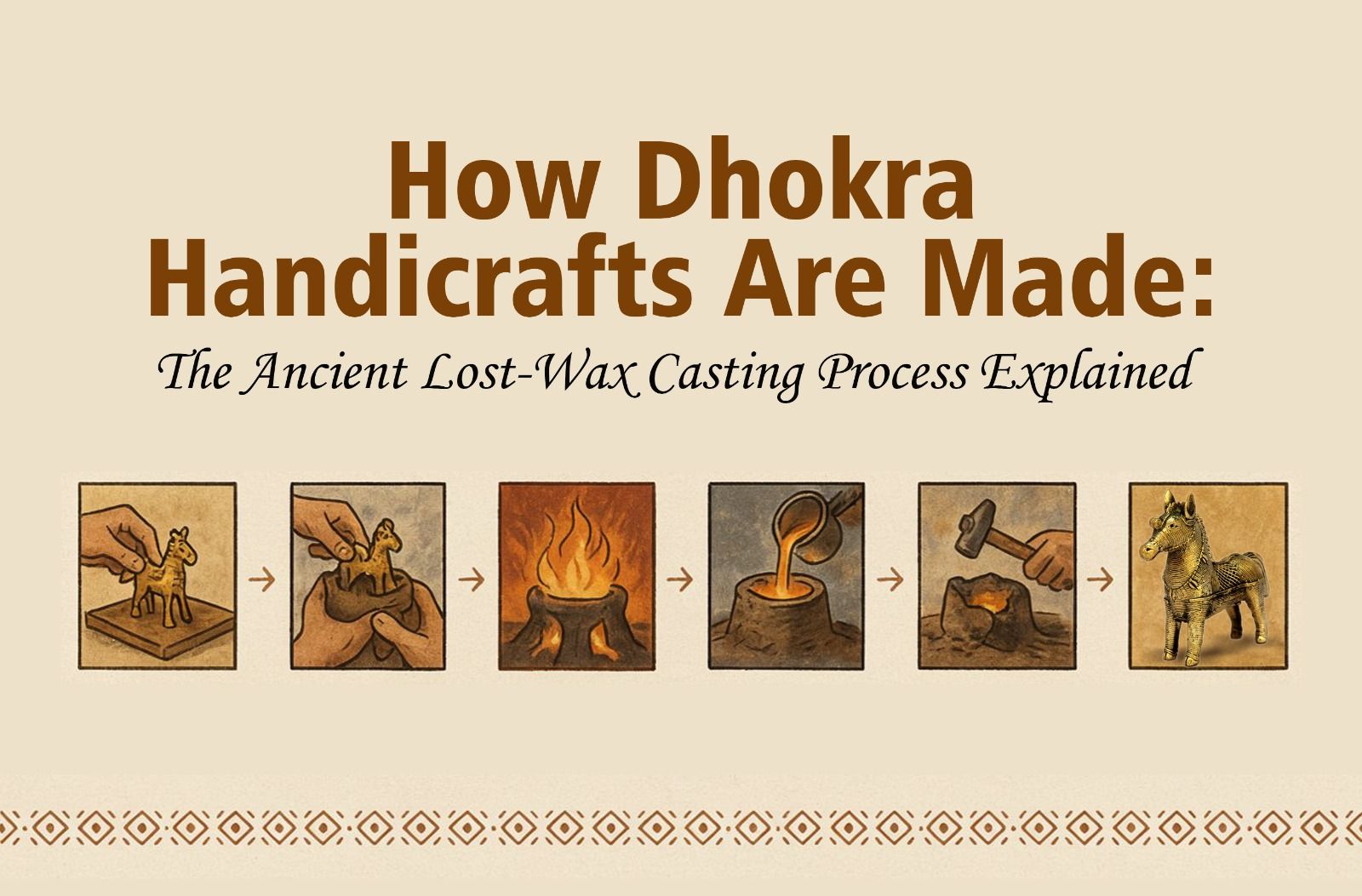
The process begins with a simple core shaped from clay, mud, and other locally available materials. This core determines the size and basic form of the object.
Then comes wax.
The artisan carefully applies wax over the core, shaping faces, limbs, clothing, ornaments and decorative details by hand. Thin wax threads, coils, and strips are added to form geometric patterns, floral designs, tribal motifs, and textured surfaces.
Can a machine reproduce the tiny variations created by human fingers? It may copy a pattern, but not the instinct, pressure and imagination behind it.
Once the wax model is complete, layers of clay are applied around it to form the outer mould. After drying, the mould is heated. The wax melts and flows out, leaving behind an empty cavity in the exact shape of the design.
This is the “lost” in lost-wax casting.
What happens next feels almost magical. Molten brass or a brass-based alloy is poured into the hollow space. The metal fills every curve, line, and detail once occupied by wax.
After cooling, the clay mould is broken.
The wax has vanished. The mould has disappeared. Yet the artwork remains.
Are Imperfections Really Imperfections?
The newly revealed piece is cleaned, refined and polished. Excess metal is removed, rough edges are smoothed and the surface may be treated to achieve Dhokra’s familiar earthy, antique finish.
Small variations in texture, proportion or pattern are not defects. They are evidence of the artisan’s hand. They tell you that the piece was not stamped out by the thousands.
Would you rather own something perfectly identical to everything else, or something shaped one detail at a time?
Why Does Dhokra Still Matter Today?
Dhokra may be ancient, but it belongs beautifully in modern life. A figurine can become a statement piece in a contemporary home. Jewellery can turn tradition into personal style. A handcrafted lamp, sculpture or collectible can become a thoughtful gift with meaning beyond appearance.
Traditional designs often draw from village life, music, dance, wildlife, faith, folklore and everyday occupations. So when you bring home Dhokra, are you buying décor, or are you carrying forward a fragment of cultural memory?
Choosing authentic Dhokra Handcrafted Products also supports artisan communities, preserves traditional skills and encourages younger generations to continue learning the craft.
In a world filled with fast, identical production, Dhokra asks us a simple question: what do we value more, speed or a story made by hand?
The wax disappears. The mould breaks. The metal endures.
And perhaps that is the true beauty of Dhokra: something temporary gives way to something timeless.
Which story will you choose to bring home?