
Why Lord Jagannath Is Worshipped in an Unfinished Form: The Story Behind the Divine Icon
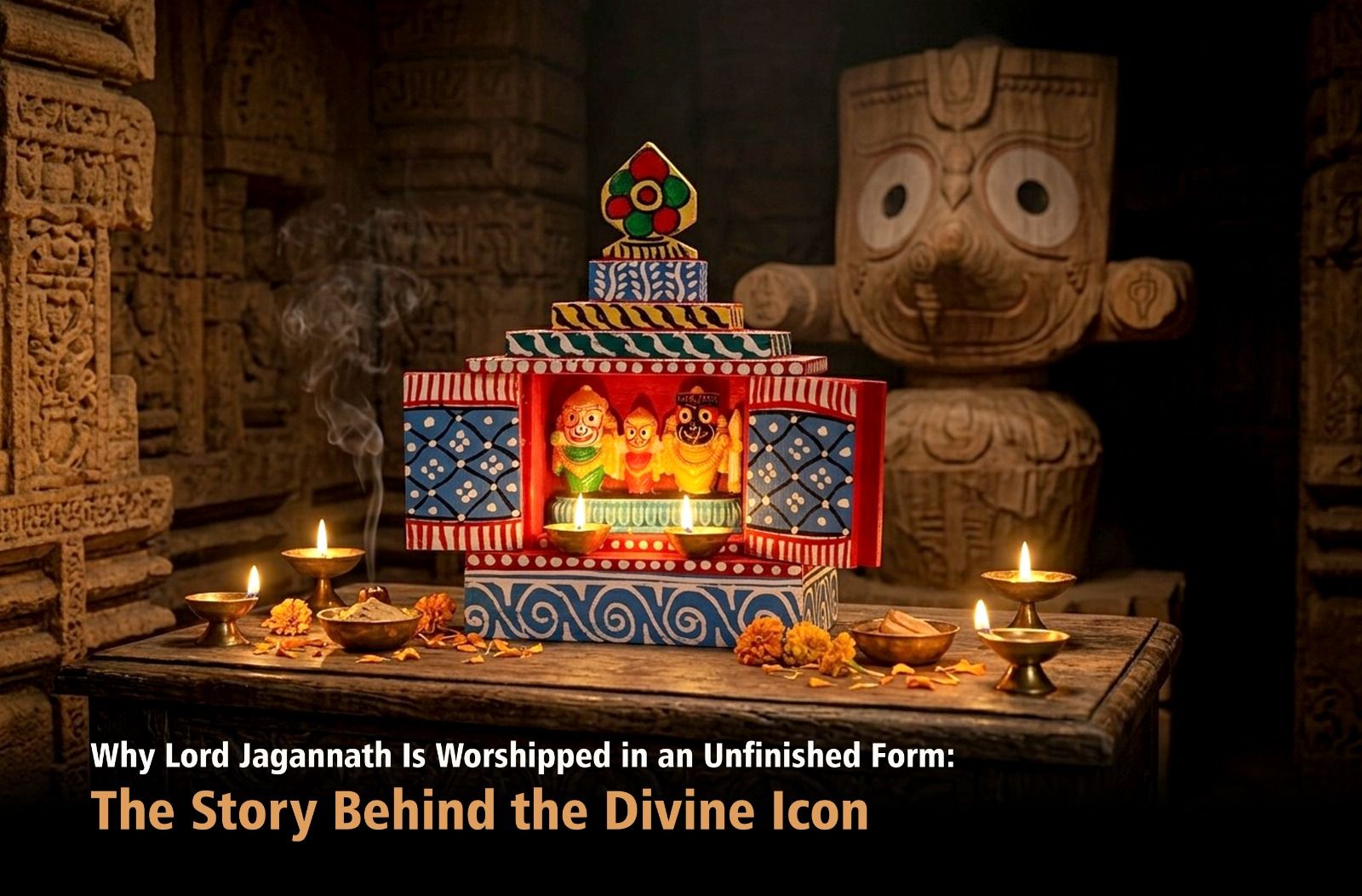
How can a deity without fully formed hands and feet become one of the most worshipped forms of Lord Vishnu? Why has His appearance remained unchanged for centuries? Is the unfinished form a mistake or a divine message?
At first glance, Lord Jagannath's idol may seem unusual. But behind those large, compassionate eyes lies a centuries-old legend that has shaped the spiritual identity of Odisha. His unfinished form isn't a flaw; it is a timeless reminder that the Divine exists beyond the limits of human craftsmanship.
The Legend of the Unfinished Idol
The most widely accepted legend is narrated in the Skanda Purana and other traditional texts.
King Indradyumna, an ardent devotee of Lord Vishnu, dreamt of Neela Madhava, a mysterious form of the Lord worshipped secretly by the Savara (Sabara) tribal community in Odisha. After an extensive search, the original deity disappeared, and the king was divinely instructed to carve new idols from a sacred neem log (Daru Brahma) that floated ashore at Puri.
A mysterious carpenter-believed to be Lord Vishwakarma, the celestial architect-offered to carve the idols with one condition:
- No one should open the workshop door.
- He must work in complete isolation for 21 days.
- If disturbed, he would leave immediately.
For nearly two weeks, no sound emerged from the chamber. Concerned for the carpenter's safety, the Queen Gundicha persuaded the King and opened the door before the agreed time.
When the doors were opened, Vishwakarma had vanished. The idols of Lord Jagannath, Lord Balabhadra, Devi Subhadra and Sudarshana remained unfinished, with rounded forms, large eyes and incomplete limbs. The king was devastated, but a divine revelation assured him that this was the Lord's chosen form and that He wished to be worshipped exactly as He appeared.
Why Is the Unfinished Form Spiritually Significant?
The form of Lord Jagannath is filled with symbolism rather than physical perfection.
God transcends physical appearance. Divinity cannot be measured by human standards of beauty or completeness.
The large circular eyes represent eternal awareness, compassion and a Lord who watches over every being without discrimination.
The absence of defined hands and feet signifies that God protects, blesses and reaches devotees without being limited by physical form.
A Deity Rooted in Inclusivity
Lord Jagannath is unique because His worship reflects a beautiful blend of tribal heritage and Vedic tradition.
Before becoming the presiding deity of Puri, He was worshipped as Neela Madhava by the Sabara community. Even today, descendants of that community, known as the Daita servitors, perform several important rituals during festivals like Nabakalebara and Anavasara. This makes Lord Jagannath one of the rare Hindu deities whose worship preserves both indigenous and classical traditions.
Dhokra Handicrafts
The timeless form of Lord Jagannath has inspired Odisha's artisans for centuries.
Among the most cherished representations are handcrafted Dhokra Jagannath idols, created using the ancient lost-wax metal casting technique. Every piece reflects not just remarkable craftsmanship but also the spiritual essence of Odisha's living heritage.
If you wish to Buy Dhokra Art Online, choose authentic handcrafted idols made by traditional artisans. Every purchase supports a centuries-old craft while bringing home a symbol of devotion, culture and timeless artistry.
More Than an Unfinished Idol To the world, Lord Jagannath's idol may appear unfinished.
To devotees, it is a reminder that:
Faith is greater than appearance.
The Divine belongs to everyone.
Perfection lies not in form, but in compassion, acceptance, and unconditional love.
Perhaps that is why millions continue to bow before Lord Jagannath-not because He looks like every other deity, but because His unique form reminds us that the Infinite can never be confined within human definitions of perfection.